
Release time:October, 27, 2026 Author:admin 

In the production workshops of many textile processing plants, "feeding fabric haphazardly into a pleating machine" has long been flagged as a common operational error. When workers fail to align the edges, allow the fabric to pile up, or neglect to smooth it out before it enters the machine, the resulting pleats often end up crooked, uneven, or irregularly spaced—typically relegated to the category of defective goods and sold off at a discount. However, an increasing number of designers and technicians have discovered that these "irregular pleats"—once destined for the scrap heap—actually harbor a unique texture unattainable through standardized production. With no two patterns ever identical, the direction of the pleats across every inch of the fabric creates a natural, random texture—a distinctive signature that sets the material apart from mass-produced, assembly-line goods.
Rather than treating these "accidental pleats" as production errors requiring rework, one can embrace their inherent characteristics to develop entirely new patterns. By breaking free from the rigid, fixed parameters of the pleating machine—without the need for additional equipment or new molds—it is possible to unlock dozens, or even hundreds, of unique, creative designs beyond standard pleat styles. This transforms an ordinary pleating machine into a catalyst for textile innovation.
Beyond Standard Practice: 3 Controllable Techniques for "Haphazard" Fabric Feeding
Many assume that irregular pleats are purely a matter of luck; in reality, by mastering specific stacking and feeding techniques, these "random errors" can be transformed into reproducible, creative processes. Each unique feeding method yields a distinct, one-of-a-kind texture.
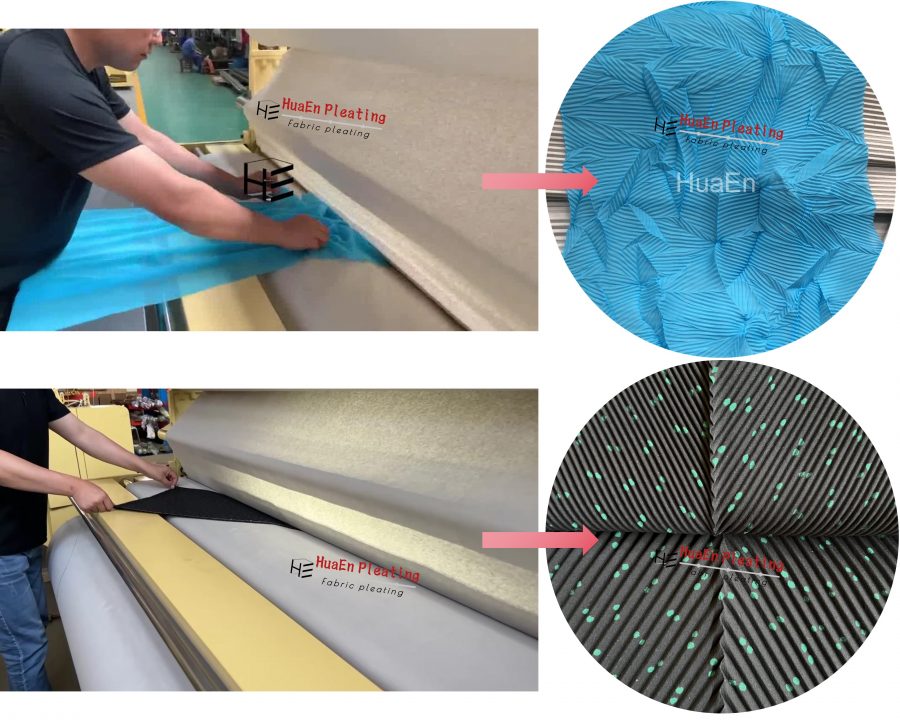
The "Crumple-and-Feed" Method: Gather the fabric—much like crumpling up a piece of waste paper—into loose, varied-sized clusters. There is no need to carefully arrange the folds; simply feed the fabric into the pleating machine while it remains in its naturally knotted and piled-up state. Following high-temperature heat-setting, the fabric surface develops a fine, intricate texture reminiscent of "chicken-scratch" wrinkles. With no uniform direction, these patterns create a rich interplay of light and shadow. When applied to lightweight, sheer materials like chiffon or georgette, they produce a hazy, matte effect with an inherent sense of fluidity—perfect for dress bodices or silk scarves, lending them an air of effortless, relaxed elegance.
Offset/Staggered Feeding: Instead of aligning the fabric precisely with the pleating machine’s guide markers, the material is shifted laterally by a few centimeters with each feed. This causes otherwise orderly straight or box pleats to distort; the spacing between pleats widens in some areas while bunching together in others, resulting in an "offset accordion pleat." This pattern retains a vestige of the original structured order while introducing irregular, staggered variations—avoiding the overly rigid, uniform look of standard pleats. When used on skirt hems or curtain valances, the pleats exhibit a more dynamic, multi-layered movement as the fabric sways.
Localized Bunching: In this technique, specific sections of the fabric are gathered or crumpled into clusters, while the remaining areas are fed into the pleating machine in a smooth, flat state. Once heat-set, the flat sections transition naturally into the fine, irregular, crumpled pleats. This method is ideal for targeted design accents—such as on shirt cuffs, dress waistlines, or the edges of cushions. The contrast between the smooth fabric and the textured, crumpled areas creates a striking tactile distinction, allowing for eye-catching design details without the need for additional fabric panels or seams.