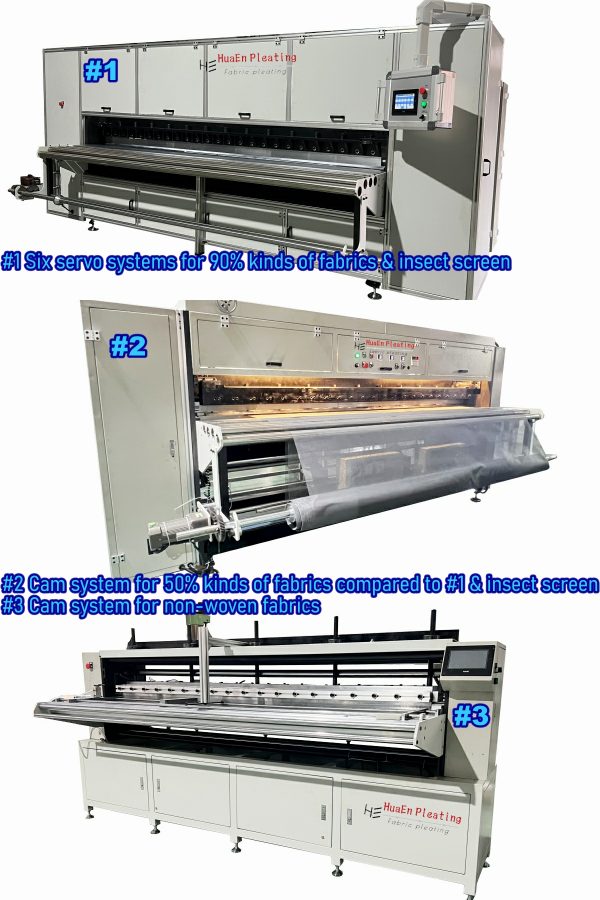
This is a full-servo automatic knife/blade-type pleating machine specially designed for producing plise perde (pleated curtains / plisse blinds), sunshade curtains, blackout fabrics, retractable mosquito/fly screens, and similar woven or non-woven materials.
Key Specifications
- Blade system: Double blade (upper + lower knives)
- Maximum working width: 3500 mm
- Pleat depth (height): Adjustable from 14 mm to 35 mm
- Control system: Full servo system (typically 6 sets of servo motors) + PLC + touchscreen
- Typical speed: Around 60–120 folds/minute (depending on material and depth)
Main Features
- Double-blade alternating action creates clean, uniform, and sharp pleats with high consistency across the full width.
- Full servo control allows precise, independent adjustment of:
- Upper and lower knife angle
- Distance between the two knives
- Distance between knives and heating plate
- Pleat height
All adjustments are done digitally on the touchscreen — no mechanical stoppers or manual screw changes needed.
- Pre-heating system (usually up to ~220 °C) helps set the pleats permanently, especially useful for polyester, PET, PP, PE mesh, and coated fabrics.
- Back-pressure system improves shape retention and prevents the pleats from opening after forming.
- Low noise operation (typically under 70 dB) thanks to the servo drive.
- Multilingual interface (commonly English / Turkish / Chinese) for easy operation.
- Suitable for continuous production of plisse blinds, honeycomb-style fabrics, insect screens, and decorative pleated curtains.
Typical Applications
- Plise perde (pleated curtains)
- Sunshade / blackout blinds
- Retractable mosquito nets / flyscreens
- Decorative and technical fabrics that require permanent knife pleats
Advantages of the Full-Servo Double-Blade Design
- Very fast changeover between different pleat depths
- High accuracy and repeatability across the full 3500 mm width
- Gentle on delicate or coated materials
- Lower maintenance compared with traditional cam-driven machines
- Easy to integrate into a production line (unwinder → pre-heater → double-blade pleater → cooling / collecting table)
How the Double-Blade System Works
On a plise perde (pleated curtain / plisse blind) machine, the double-blade system uses two opposing knives — an upper blade and a lower blade — that work in precise alternating motion to form each pleat.
Step-by-step process
1. Material Feed
The fabric or mesh is continuously fed into the pleating zone under controlled tension. A pre-heating section (usually just before the blades) softens the material so it holds the fold better.
2. Alternating Blade Action
- The lower blade rises and pushes the material upward.
- Simultaneously (or in a tightly coordinated sequence), the upper blade descends and folds the material over the lower blade.
- This creates a sharp, controlled crease.
- The blades then reverse roles for the next fold, forming the continuous accordion-style pleat.
3. Servo-Controlled Precision
Because the machine uses a full servo system, each blade is driven independently by its own servo motor. This allows:
- Exact control of the opening/closing distance between the two blades (this sets the pleat depth, e.g. 14–35 mm).
- Precise adjustment of the blade angle.
- Perfect synchronization so the folds stay uniform across the full working width (up to 3500 mm).
4. Setting the Pleat
Immediately after the fold is formed, the material usually passes against a heated plate or under back-pressure. The heat + pressure “sets” the crease so the pleat remains permanent even after cooling.
5. Continuous Operation
The process repeats at high speed (typically 60–120 folds per minute). The finished pleated web is then collected on a table or conveyor.
Why Double-Blade Is Preferred for Plise Perde
- Produces sharper and more consistent folds than single-blade or roller systems.
- Handles both rigid mesh (flyscreen) and softer fabrics well.
- Allows quick digital change of pleat height without changing mechanical parts.
- Gives better control on wide materials (3000–3500 mm) where keeping the fold straight is critical.
In short: the upper and lower blades act like a pair of synchronized scissors that repeatedly fold the material into precise, permanent pleats under servo control and heat.